Izzy, the ‘Abstract’ Mascot
To decide the mascot of the 1996 Olympic Games, the Atlanta Commission for the Olympic Games put out a call for an idea that would appeal both to kids and the rest of the world and evoke the spirit of Atlanta. The mascot had to be unisex, unracialized, and uncontroversial, and as the official representative of the Atlanta Games, it would be copyrighted and marketed on a huge scale, so nothing aesthetically generic or derivative would be allowed.

ACOG wouldn’t pay for the chosen design, so there were only a handful of submissions. One was a riff on Willie B., a gorilla in the Atlanta Zoo, and many entries tried to do something with local food. And one of the entries was designed by John Ryan, an animator for DESIGNfx: a blue, droplet-shaped entity with a tail and a big smile, created entirely on a computer. This creature, which Ryan called Hi-Rez, represented (as he saw it) Atlanta’s reputation as the Silicon Valley of the east coast, the public’s fascination with new technology at the start of the 1990s, and a child’s spirit of play. It was friendly and could morph into any kind of athlete it wanted.
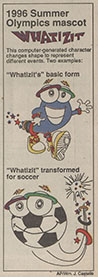
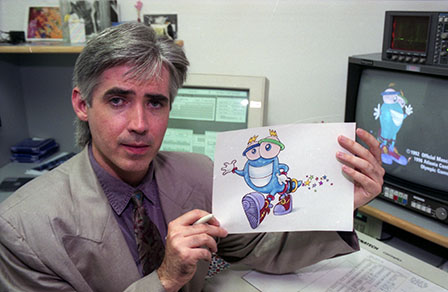
Nearly everyone in ACOG found this submission odd, but Billy Payne loved it, and the choice was made. The commission embraced the creature’s bizarre abstractness and, in an immortal decision, named it after the first question many people asked upon seeing it: Whatizit. The mascot was introduced to the world as a large costume during a dance routine at the closing ceremony of the 1992 Barcelona Games.
The backlash was immediate and strong. Whatizit was weird to say, strange to look at, and almost impossible to understand. It seemed to represent nothing at all, and especially not Atlanta, a city that was already tense about how it was about to showcase itself. ACOG quickly knocked out a slightly new design and consulted a focus group of children to draft a new name, then a second group to pick the best option. “Kirby” won, but was already owned by Nintendo, so ACOG went with second place, a name that sounded like Whatizit’s nickname: Izzy.
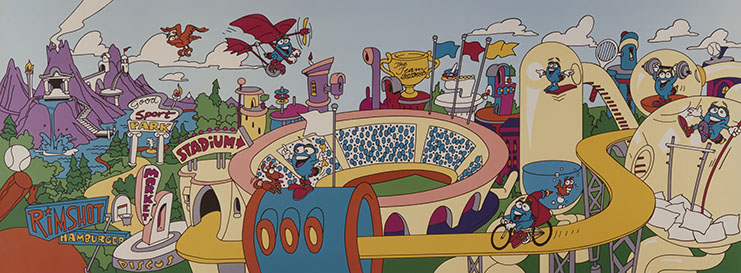
For the next four years, Atlanta remained furious over its bright blue, conceptually ambiguous mascot. Adults—journalists in particular—hated his bland, meaningless appearance that seemed to have nothing to do with their town, but children loved him, perhaps for the same reasons (he’d been given a gender, a more generic cartoon smile, and big sneakers). ACOG marketed Izzy to kids around the state on backpacks, basketballs, hairbows, wristwatches, in a computer game, and especially as the huggable Izzy plush, to the tune of about $25 million, or a quarter of the total royalty revenue during the Games.
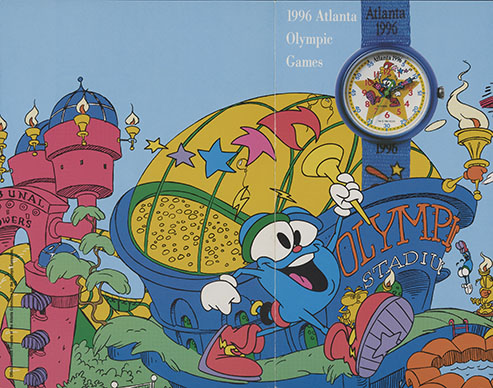
Izzy was the first—but not the last—“abstract” mascot, as well as the first made with Computer Generated Imaging (CGI). And, as a few journalists at the time pointed out, in many ways he was the perfect icon for these particular Olympics for the precise reason that he was so infuriating: his blankness represented the worst fears of a city that didn’t know how to represent itself.