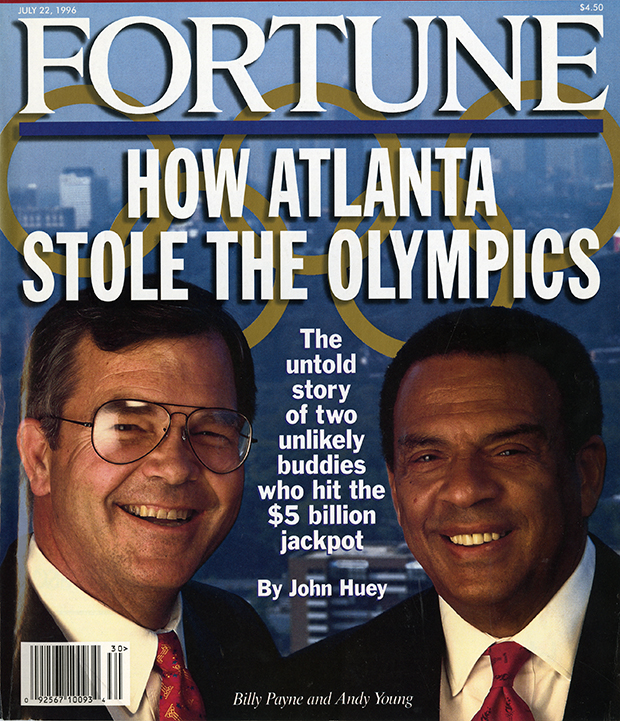
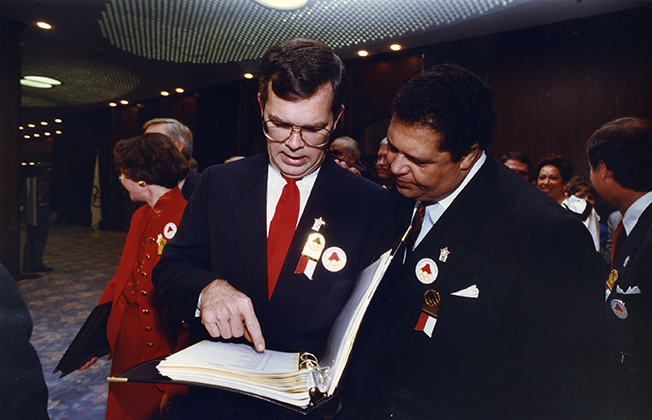
Billy Payne and Andrew Young make the cover of Fortune, from the Hula papers, M247-013-012
Billy Payne was an attorney living in Atlanta when, in the fall of 1986, he had an idea. He convinced Mayor Andrew Young of its merit, and soon they had formed a modest coalition to pitch it to the United States Olympic Committee: Atlanta should host the 1996 Summer Olympic Games.
To the surprise of many Americans, Atlanta beat out Minneapolis as the States’ official candidate for the International Olympic Committee’s consideration in 1988. Payne, Young, and others had pitched an idea of an Atlanta that didn’t quite exist, but one they hoped could be created for the world stage: the beautiful downtown space famous for southern hospitality and triumphant civil rights activism.
Atlanta was a controversial pick, since most host cities, like London and Athens, Greece, were already known around the world for a strong cultural identity. But when the IOC selected Atlanta as its next host in 1990, no one quite knew what “Atlanta” looked like.
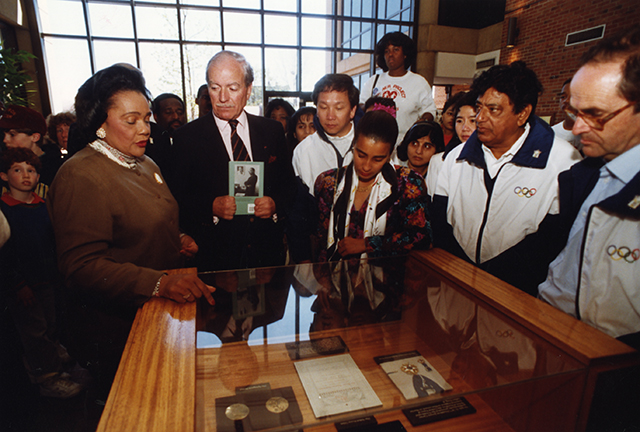
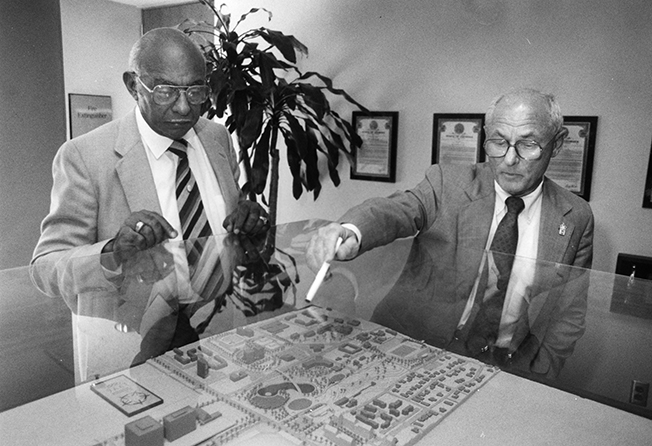
Coretta Scott King gives I.O.C. members a tour of the Martin Luther King Center, 6 April 1990, from the Atlanta Journal-Constitution Photographic Archives, AJCP217-012hI.O.C. member views a potential model of the proposed Olympic Centre, 3 October 1989, from the Atlanta Journal-Constitution Photographic Archives, (I.O.C. member views a potential model of the proposed Olympic Centre, 1989), Atlanta Journal-Constitution Photographic Archives, AJCP217-012i
The Atlanta Commission for the Olympic Games (ACOG) had a colossal task ahead of them. Atlanta had no iconic building, little viable downtown space for millions of tourists, and no real self-image beyond the wounded town that barely survived the Civil War and the decades of harrowing racial violence that followed during the twentieth century. ACOG would have to create a temporary version of Atlanta to show off and, they hoped, jumpstart a permanent revitalization.
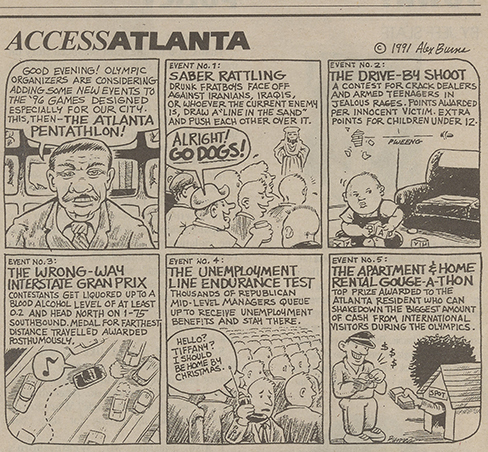
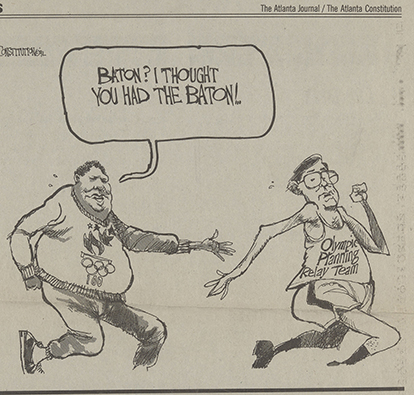
Cartoon from the Access Atlanta newspaper, satire, 1991, from the Hula papers, M247_004__002_001
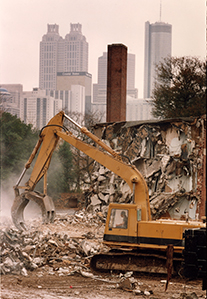
Billy Payne and Maynard Jackson during the Tokyo presentations for the Olympic announcement, 18 September 1990, Atlanta Journal-Constitution Photographic Archives, AJCP489-080dExcavator demolishing Techwood Homes, Atlanta, Georgia, November 17, 1993, Atlanta Journal-Constitution Photographic Archives, AJCP312-005e
To fund Olympic construction without public money, ACOG would use ticket sales, corporate sponsorship (Coca-Cola, first and foremost), and the private investments of local businesses, many of them new. Federal money would be used to improve public spaces downtown, sprucing up parks, building streetlights, planting trees, and funding public art. ACOG enlisted the help of many statewide and downtown sports venues that already existed, such as the large gymnasium at Georgia State University (which would eventually host Olympic badminton), and GSU’s enthusiastic body of student and faculty volunteers. Space downtown was also privatized and leased to small vendors, who could sell food and merchandise off the sidewalk. But since the Games required more stadiums, housing for athletes, and pretty spaces for out-of-towners (and international news cameras) to walk through, ACOG and the Neighborhood Planning Unit determined that many buildings that already existed downtown—and in neighboring communities like Summerhill and Peoplestown—would need to be radically altered.
From the Atlanta Journal-Constitution newspaper, circa 1994, editorial section, cartoon of Billy Payne passing an empty hand to then Mayor Maynard Jackson illustrating someone dropped the baton when it comes to planning, Hula papers, M247-010-008-001
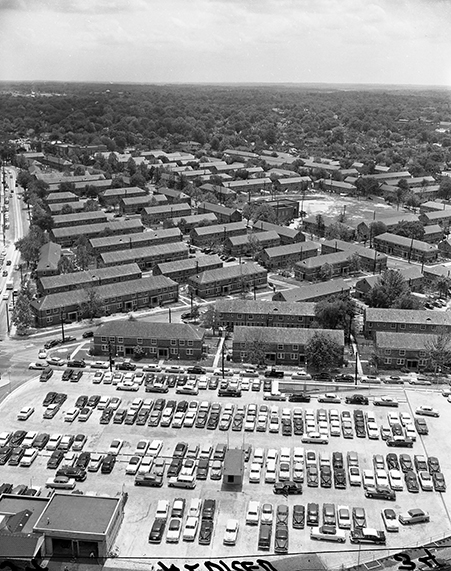
Techwood Homes public housing, Georgia, October 1950. Atlanta Journal-Constitution Photographic Archives, AJCNS1950-10-00o
The problem was the difference between the ideal “Atlanta” pitched for the Olympics and the Atlanta that most of its citizens actually lived in. Real-time visuals that confirmed Atlantans’ and visitors’ perception of the low quality of life that the city offered its Black citizens were directly counter to the middle-class life and “Southern hospitality” that ACOG wanted it to be known for. Therefore, getting downtown ready for international television meant getting rid of everything that the many committees planning the Games didn’t want Atlanta to look like. Bad sidewalks could be fixed, but unseemly public housing clashed with the businessmen’s ideas of a comfortable middle class.
“Our goal was that no one was going to be thrown out to build a parking lot. Whatever it took, we would go the extra mile to accommodate them,” said MAOGA attorney Dwan Packnett. “I’m proud of what we did.”
Excerpt from the Journal of the Metropolitan Atlanta Olympic Games Authority, Hula Collection, M247-015-006
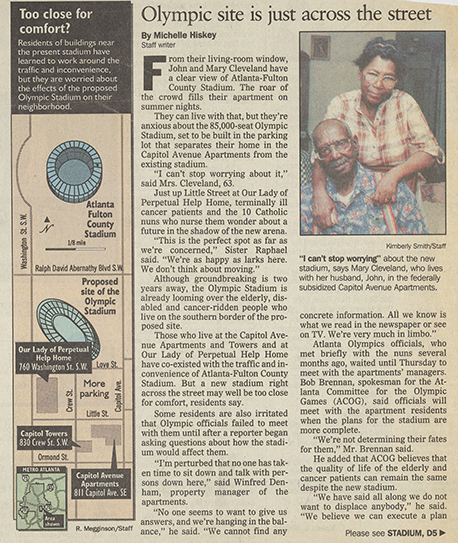
The Atlanta Housing Authority took over, bulldozed, or transformed many of these buildings, displacing the residents without rehousing many of them or allowing them to return after the Games concluded. Techwood Homes, a deteriorating, nearly-1,000 unit public housing complex that had been placed on the National Register of Historic Places in 1976, was demolished and turned into Centennial Place; low-income residents in Peoplestown, Summerhill, and Mechanicsville, who had lived there for decades, were removed to make room for the Centennial Stadium and the Olympic Stadium.
Article from the Atlanta Journal-Constitution describing the dislocation for many residents in the line of fire of stadium construction, Hula papers, M247_004_002_003
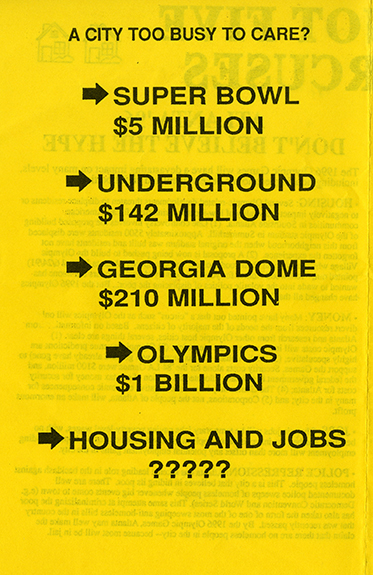
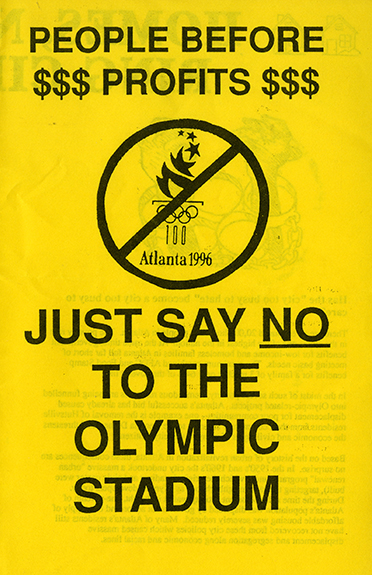
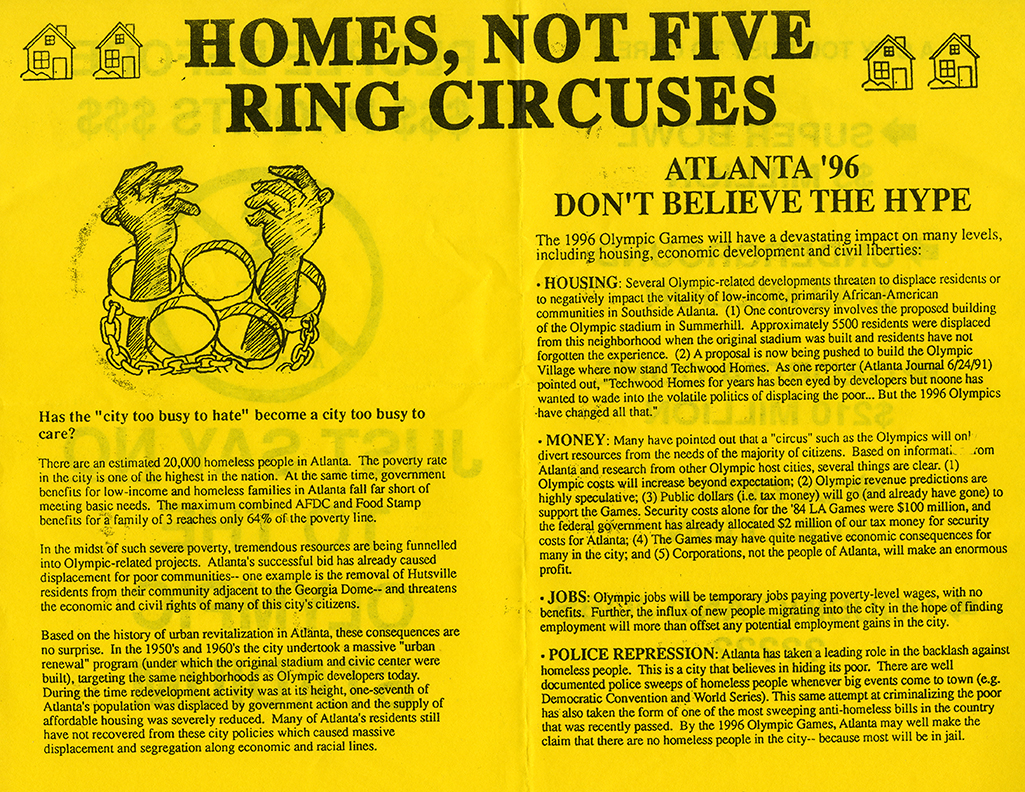
Flyer advocating for residents to fight the construction of the stadium, Hula papers, M247-003-004_001
Low-income residents protested the stadium building site in Summerhill, but all Olympic construction was carried out by Billy Payne’s ACOG, which was a private business venture that had none of the state’s legal obligations to the community and heard no public feedback. The aggressive new layout moved poor Black residents out to house the temporary sports community, and once the Summer Games were over, middle-class renters moved in. Physically relocating the lower class to make an area look better for visitors isn’t a phenomenon unique to Atlanta, but it’s a pattern tragically familiar to Atlanta’s low-income residents.