Business Booms
Georgia Avenue in the 1940s and 1950s
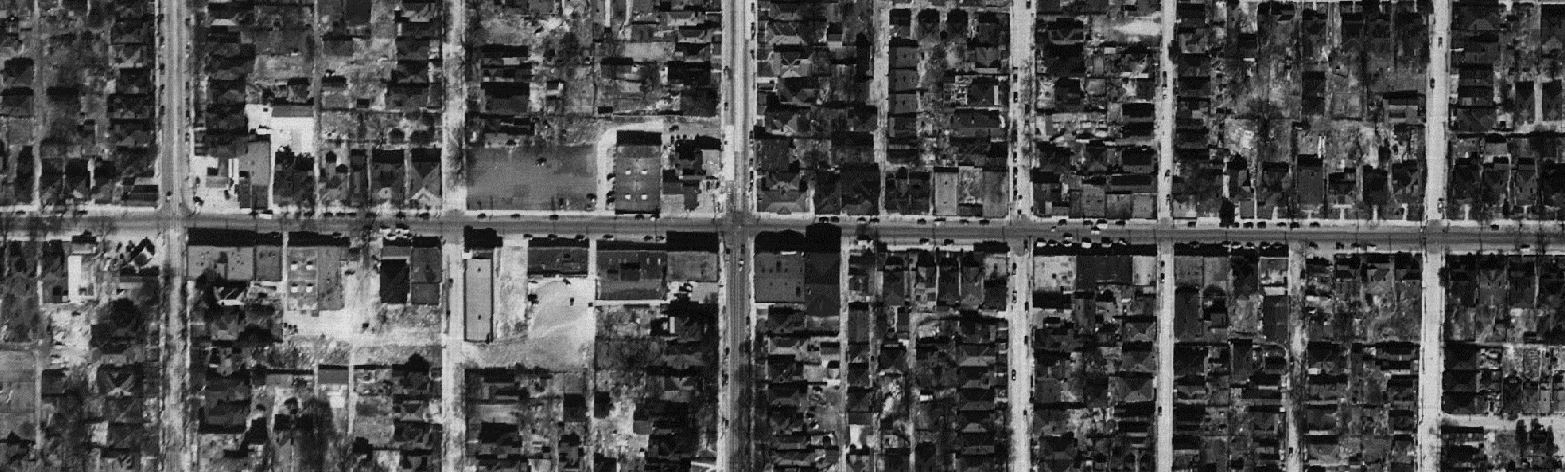
Click here to see this aerial photograph as an interactive overlay on a current street map (courtesy of GSU LIbrary’s Digital Collections)
Summerhill was primarily a Black neighborhood and the Southside primarily white – but the line dividing them was porous. Some whites lived and owned small retail businesses in Summerhill, where their customers included the neighborhood’s ample Black middle class. African Americans constituted a quarter or even half of the residents on a few Southside streets, though they were often relegated to “rear” rentals in the back of homes or apartments, or to makeshift alley shacks.
At some point in the early twentieth century, Black homeowners established a small enclave right in the center of the Southside. Walter Banks, who was hired as a gameday usher for the Atlanta Braves in 1966 and stayed with the team for 57 years, grew up in that pocket of Black Southside settlement, on Pulliam Street north of Georgia Avenue, in the 1940s and 50s.
Click “Play” arrow to hear a short interview with Walter Banks
Like so many who spent their childhood around Georgia Avenue in the middle of the twentieth century, Banks remembered it feeling like “a little, small downtown. Everything you needed, almost, was on Georgia Ave.” His mother, Lillian, shopped for groceries at Austin’s, one of two new supermarkets in the neighborhood. Large, self-service supermarkets were a novelty for American shoppers; most grocers still fetched and individually packaged items for customers one at a time, and consumers had to patronize multiple specialty stores to fill their kitchen pantries. Supermarkets sold not only fruits and vegetables, but canned goods, mass-produced bread, and household items as well – and they had butcher counters in-house.
Georgia Avenue had two supermarkets by the early 1950s: Austin’s on the shopping district’s western side, and Howard’s (which was taken over by the Buehler’s chain in 1955) to the east. As an added enticement for shoppers, Austin’s offered their customers the chance to sign their receipts and stuff them in a lottery drum. When the store manager pulled a name and awarded a prize to the winner, huge crowds from the surrounding neighborhoods filled the street outside. “That was as close as I remember” to anything resembling “integration” in mid-century Atlanta, Banks mused.
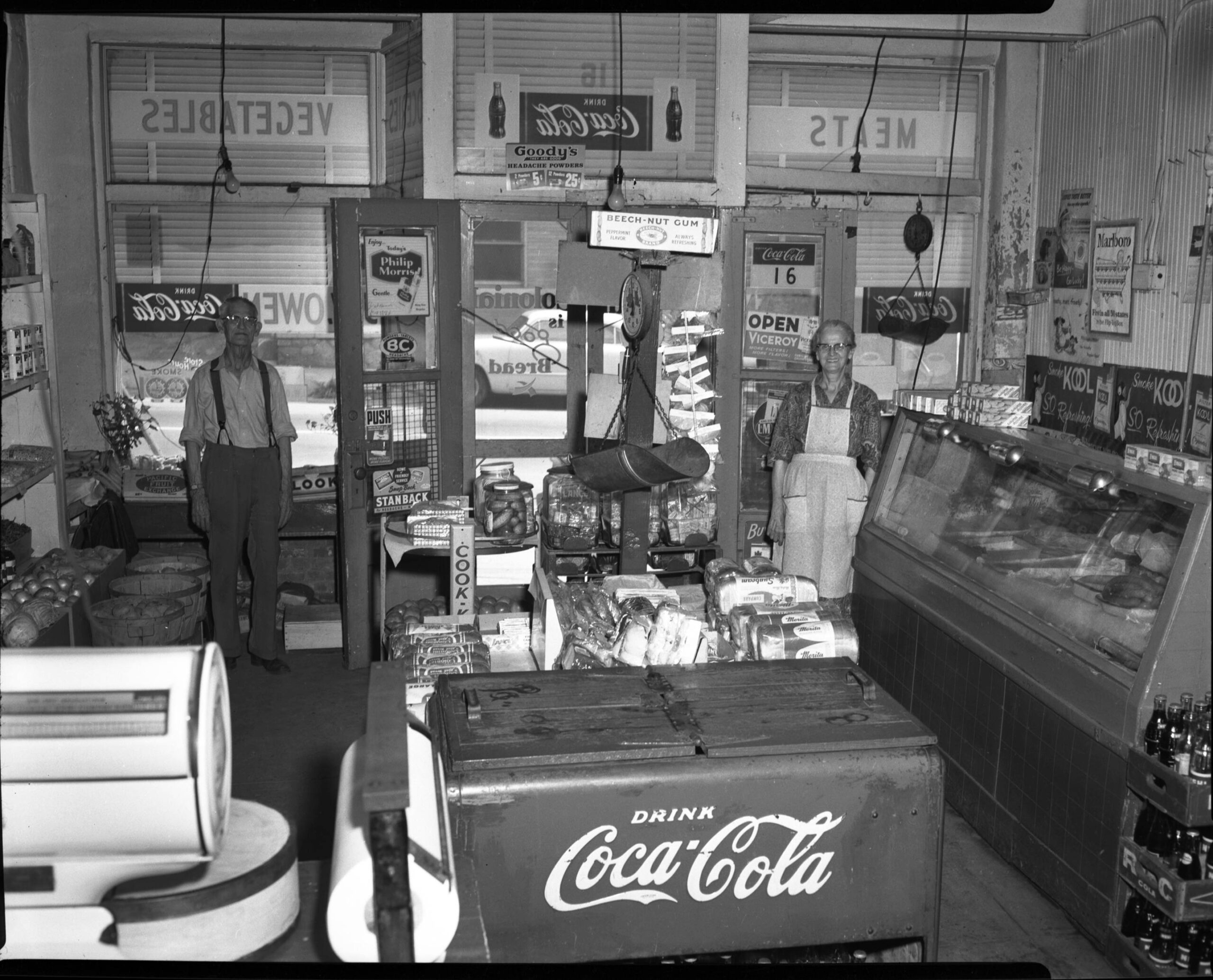
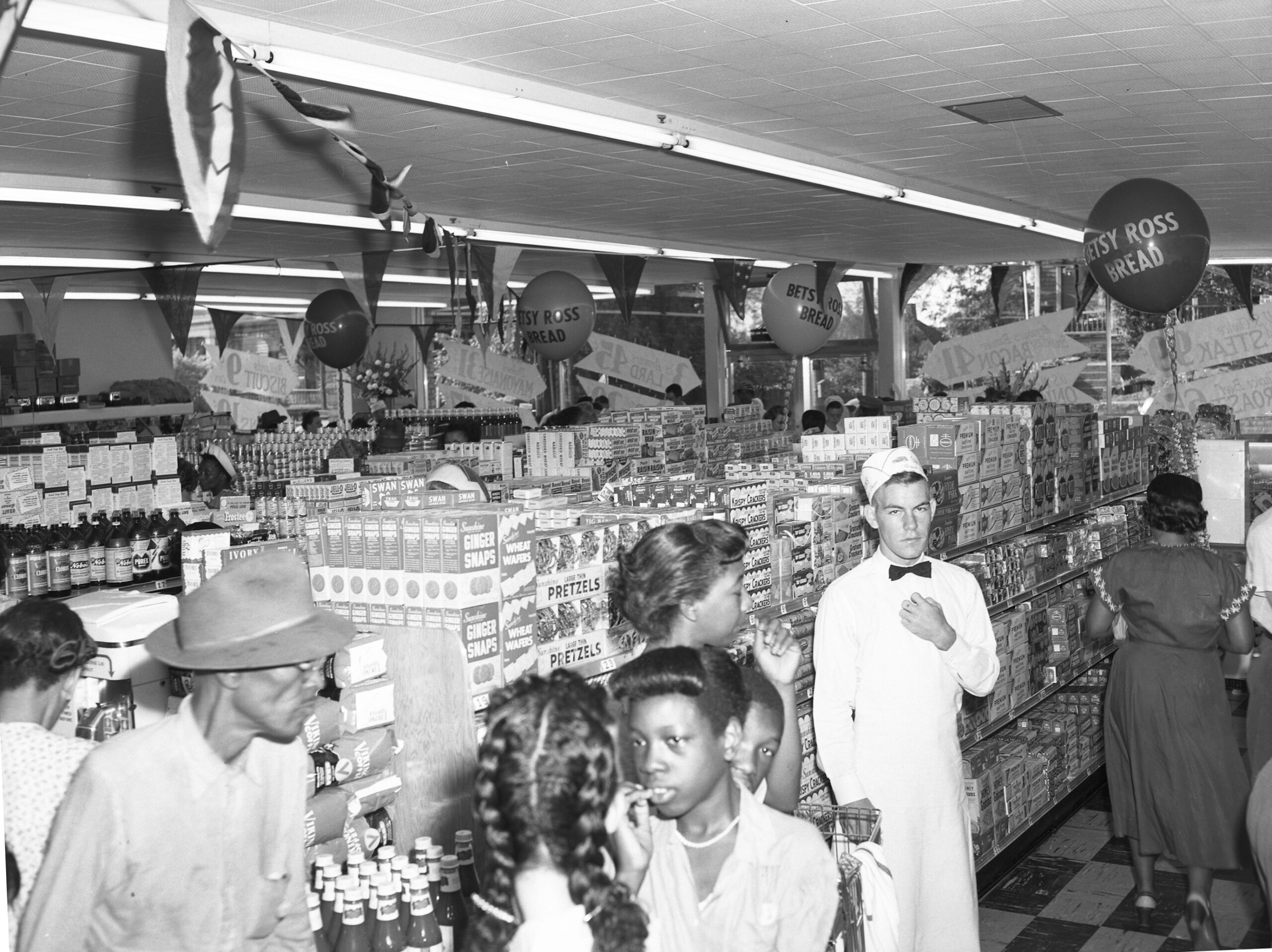
These were Georgia Avenue’s most commercially dynamic decades. By 1950, fifteen grocery stores of all sizes, two bakeries, two dairy stores (including French’s Ice Cream, where Banks recalled buying a double-scoop cone for ten cents), a kosher delicatessen, and six dine-in restaurants lined the Avenue. The five-and-dimes selling inexpensive general merchandise and household goods were interspersed with new and used clothing stores, as well as shoe repair shops.
You could also buy liquor on Georgia Avenue. The state of Georgia had been “dry” since 1908, and even though National Prohibition was repealed by the Twenty-first Amendment in 1933, distilled liquor was still illegal in Fulton County until 1938. In 1940, there was one liquor store on Georgia Avenue, at the westernmost edge of the commercial district. By 1950, beer, wine, and liquor could be bought by the bottle in four stores along the central shopping area.
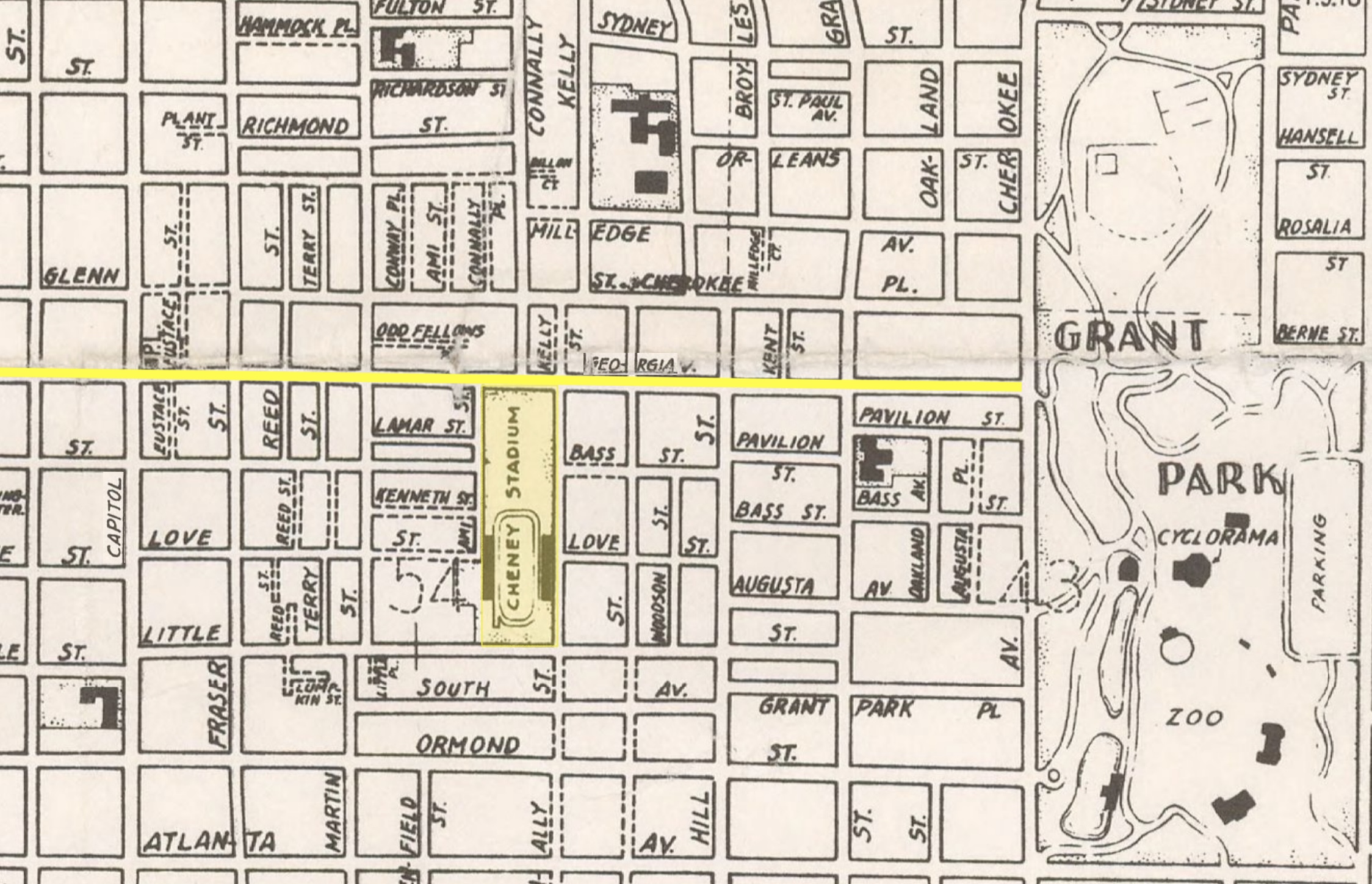
Further east, between Martin and Connally Streets, the Atlanta Board of Education built Cheney Stadium. Even though it was bounded by the Black residential streets of Summerhill, Cheney was designated as white-only, to be used by several white high schools south of Ponce de Leon Avenue.
Section of Map of Atlanta, 1959. Georgia Avenue and Cheney Stadium in yellow.
Click here to see full map as an interactive overlay on a current street map (courtesy of GSU Library’s Digital Collections)
Summerhill leaders protested to the Board of Education that the city had promised this land to the surrounding Black neighborhoods. They also worried that if thousands of white football fans were turned loose in a community like Summerhill, racial tensions, even violence, might ensue. Anyone familiar with Georgia Avenue today knows that sports facilities have long dominated the local landscape. This was the first time a sports arena was imposed upon Summerhill, against the neighborhood’s wishes and without its consent; more instances were to come.
Racism’s cruelty was also felt inside Georgia Avenue’s stores. Walter Banks’s fond memory of the unusual scene outside the supermarket, where all customers stood shoulder to shoulder, equally hopeful that they might win a prize, speaks to an inevitable truth of most white-owned commercial space in the American South in mid-century: Black customers were made to feel that their patronage was unwelcome, their money less valuable. Civil rights leader Ruby Doris Smith Robinson, who grew up in Summerhill, rejected this type of demeaning treatment in a Georgia Avenue drugstore as a young teenager. When she and her younger sister Catherine (who previously spoke about the E.P. Johnson School) ordered an ice cream cone from a store’s soda fountain, the white clerk handled the cone with disdain, preparing it with bare hands rather than with a paper wrapper. Ruby Doris refused to buy it: “you’re not going to put your hands on my cone,” she protested, pointing out that white customers’ cones were always wrapped in paper.