The Man with the Olympic Torch
But Doug Dean was from Summerhill, too. He believed the Olympics would bring jobs to the neighborhood, as well as new residents — perhaps even middle-class residents, who would raise Summerhill’s profile as well as the local median income. For Summerhill’s revitalization to be healthy and sustainable, he insisted, it needed a mix of residential incomes. So he sought developers who would build both affordable and market-rate housing.
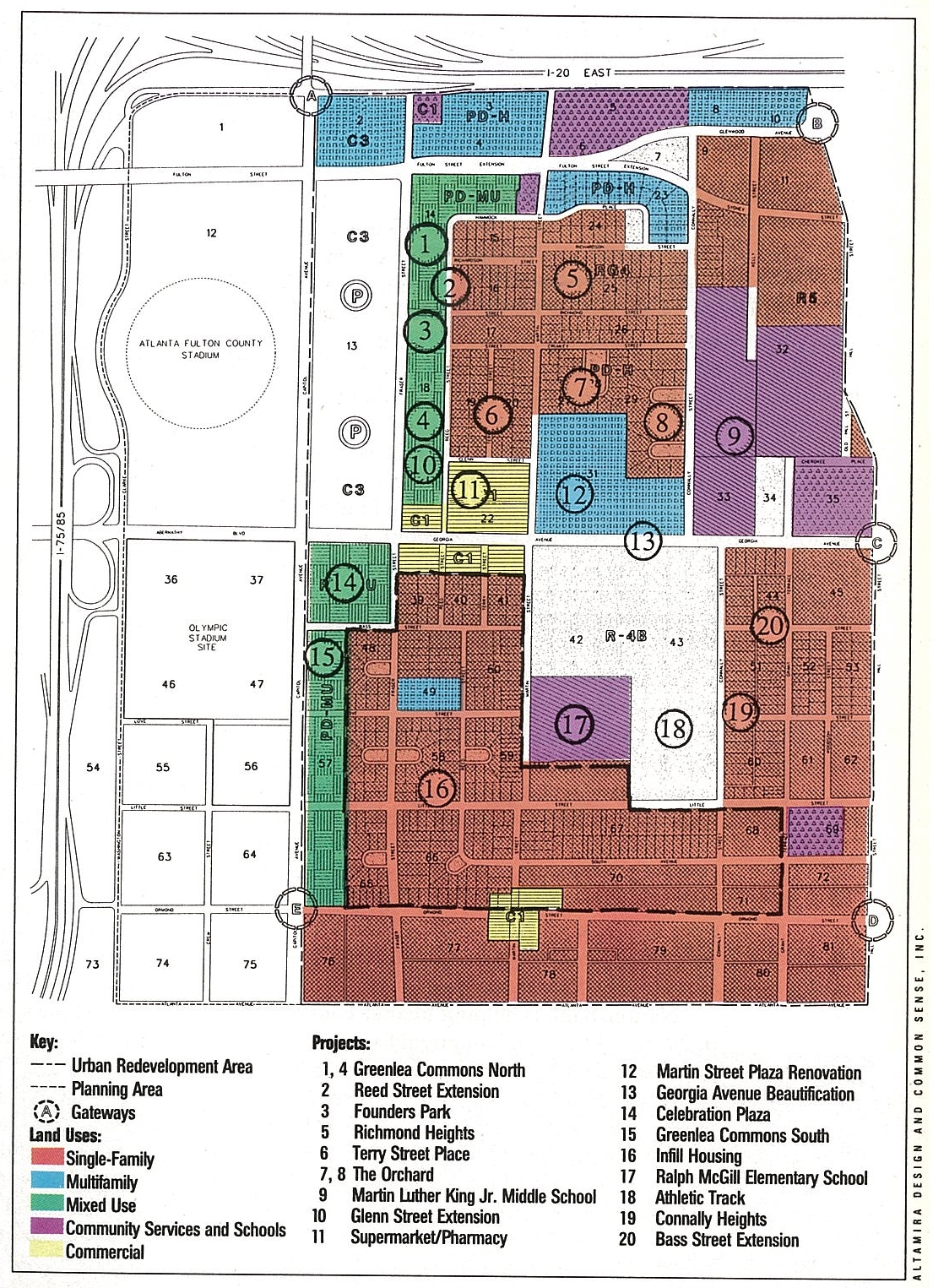
Dean was especially motivated by the possibility that the Olympics would launch Georgia Avenue’s revival. He envisioned revitalized city blocks, replete with gleaming new stores where neighborhood residents could do their shopping and Olympic visitors could appreciate Black Atlanta’s long and storied history. “I want the man with the Olympic torch to run down Georgia Avenue,” he proclaimed.
Stadium Area Planning Map, 1995. Georgia Avenue’s commercial district is the yellow area at the center of the map, referred to as “11: Supermarket/Pharmacy.”
He started with an audacious plan to redefine Summerhill by expanding its boundary westward. Under his leadership, the neighborhood came to encompass both sides of Capitol Avenue. Now both the Atlanta-Fulton County Stadium and the new Olympic site had become part of Summerhill.
By the summer of 1995, several moderate-income housing developments were breaking ground in the northern part of the neighborhood. And Georgia Avenue’s commercial buildings had a new owner: John Elder, who owned dozens of vacant properties in Summerhill and Mechanicsville (which he rented out as game-day parking lots). But efforts to bring a Kroger Supermarket, or any other new retail, to the street had failed. With just a year to go until the world arrived in Summerhill, the neighborhood was still a food desert, and Georgia Avenue remained, as one reporter wrote, an “eyesore.”
With the more immediate needs of the Olympics in mind, neighborhood representatives proposed that ACOG rent ten Georgia Avenue storefronts east of Capitol Avenue for storage and staging during the Games. Redevelopment funds would be used to renovate the buildings. Once the Olympics were over, the Summerhill Neighborhood Development Corporation [SNDC], a non-profit real estate development entity, planned to purchase the buildings from Elder.
The city agreed to the proposal, and a total of $1.3 million in federal, city, and private funds were allotted for Georgia Avenue’s storefront renovation. An urban design class from Georgia Tech pitched in free labor for planning and implementing streetscape improvements. Old-fashioned street lamps that evoked an imagined version Georgia Avenue’s past were installed. “There won’t be much blight on Georgia Avenue by the time the Games get here,” a local Olympics official promised.