The Olympics Come to Georgia Avenue
In 1990, to the surprise of many, the International Olympic Committee chose Atlanta as the site of the upcoming Olympic Games. The Atlanta Committee for the Olympic Games [ACOG] needed to build or repurpose more than two dozen arenas and sports centers. It went without saying that Summerhill, already home to a stadium with a seating capacity of 60,000, would play some role in the games.
Doug Dean viewed this development with cautious optimism. A neighborhood representative and tireless Summerhill booster, Dean believed that when visitors from the world over arrived in Atlanta, the city would want to ensure that the neighborhood looked vibrant and livable, not blighted and forsaken. This was an unparalleled opportunity, he felt, to bring Summerhill’s distress to the attention of the city’s power structure, and to get the resources it so desperately needed. He started reaching out to the city’s political leaders (who were, by 1991, mostly Black) and business elite (who were almost all white) to coordinate Summerhill’s Olympic rebirth.
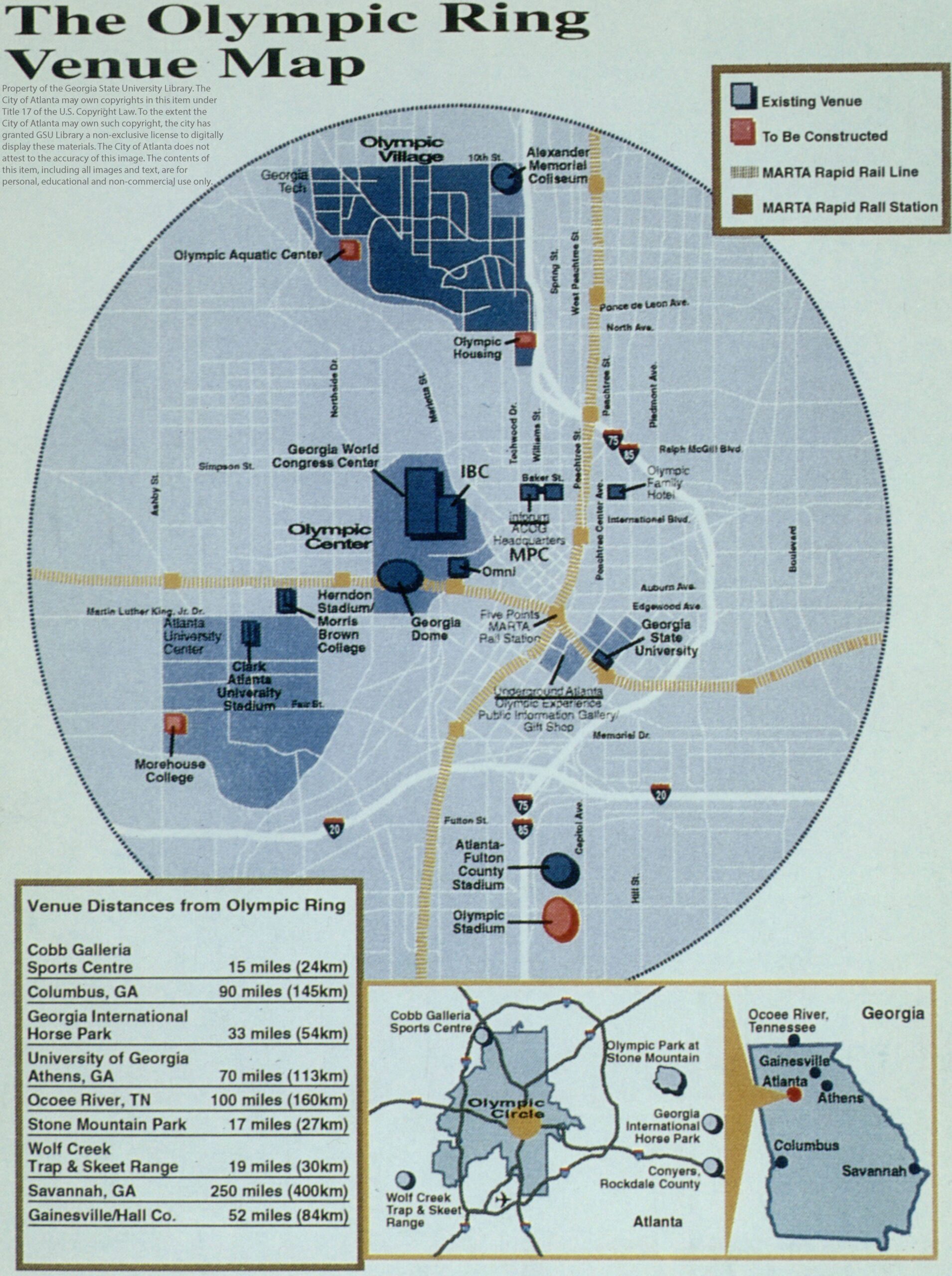
What Dean did not yet know was that Billy Payne, the president and CEO of ACOG, had already picked the neighborhoods around the Atlanta Stadium as the location for the new Centennial Olympic Stadium – an 85,000-capacity facility, to be built on the south side of Georgia Avenue, across the street from the stadium where the Braves played.
No one from Summerhill or any of the surrounding neighborhoods had been consulted.
Olympic Ring Venue Map, 1996
Atlanta-Fulton County Stadium and the Olympic Stadium are the venues furthest south on the city map.
Hoping to pacify neighborhood activists who regarded the news with horror and anger, ACOG made several promises to the neighborhood. For one, they promised that the stadium neighborhoods would be home to two massive sports facilities only briefly; once the Olympics were over, the old stadium would be demolished, and the Braves would move into the new stadium. For another, the Braves would give 8.25% of their gross parking revenue to local neighborhood organizations. This amounted to tens of millions of dollars of revitalization funds, which caught the attention of real-estate developers eager to capitalize on the Olympic project. Finally, the centrality of the city’s African-American history was recognized when the city renamed a section of Georgia Avenue, from Capitol Avenue heading west; now it would be called Ralph David Abernathy Blvd., in honor of the religious and civil rights leader who had passed away in 1990.
Some Summerhill, Mechanicsville, and Peoplestown residents, however, remained unpacified. Local activists like Mattie Jackson, Ethel Mae Matthews, and Columbus Ward – advocates for racial, economic, and housing justice since the late 1960s and early 1970s – made no secret of their suspicions of Olympic planners and their associates.
Matthews, a founder of Atlanta Neighborhoods United for Fairness [A’NUFF], demanded that the new stadium be built in a part of the city that hadn’t already been crushed by several decades of urban renewal projects. “If they build it,” Matthews declared in 1991, “they’ll sure say they had hell on their hands.”
Protesters at the home of ACOG President and CEO Billy Payne, 1991
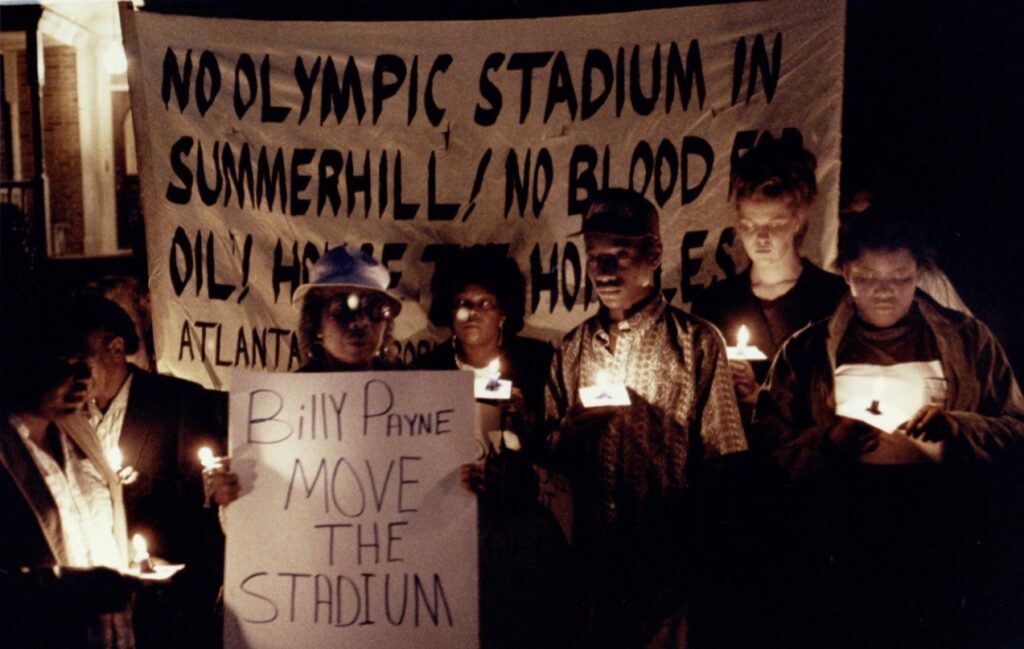
As it became clear that ACOG would not change its plans, A’NUFF shifted its goal, calling for neighborhood inclusion in decisions about parking infrastructure and affordable housing. “People who call the shots don’t care about people down here,” insisted Columbus Ward. “We need people in the neighborhoods to make decisions about what will happen.”