Neighborhood Erasure
Georgia Avenue in the 1960s and 1970s
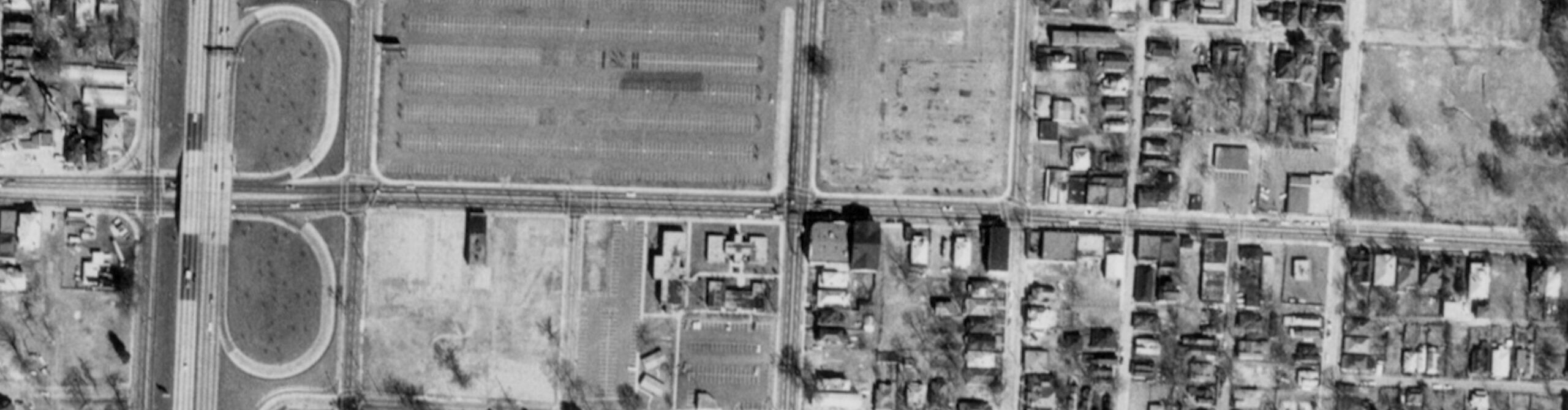
For the next two decades, one block after another of Georgia Avenue dematerialized. By 1966, the north side of the street between Capitol, Crew, and Washington had been demolished, snuffing out a beauty shop, a barber shop, a grocery store, and French’s Ice Cream. A few years later, the south side of those blocks – where the Empire Theater, Austin’s Super Market, and Jacobs Pharmacy had served the neighborhood for forty years – were gone too. The north side of Georgia Avenue from Capitol to Fraser was also torn down in the mid-1960s, which obliterated the Carnegie Library, Charles Maloof’s Liberty 5&10, and everything in between.
Georgia Avenue’s transformation paralleled changes in its surrounding neighborhoods. The Southside neighborhood was gone, replaced by twisted knots and snaking tendrils of interstate highway infrastructure, as well as a gargantuan new baseball stadium surrounded by thousands of parking spaces.
The stadium was the brainchild of Mayor Ivan Allen Jr. The land had originally been slated for whites-only public housing; Black leaders protested, pointing out that Black Atlantans, who constituted the majority of displaced residents, desperately needed affordable housing options. But city leaders would not approve Black public housing so close to downtown.
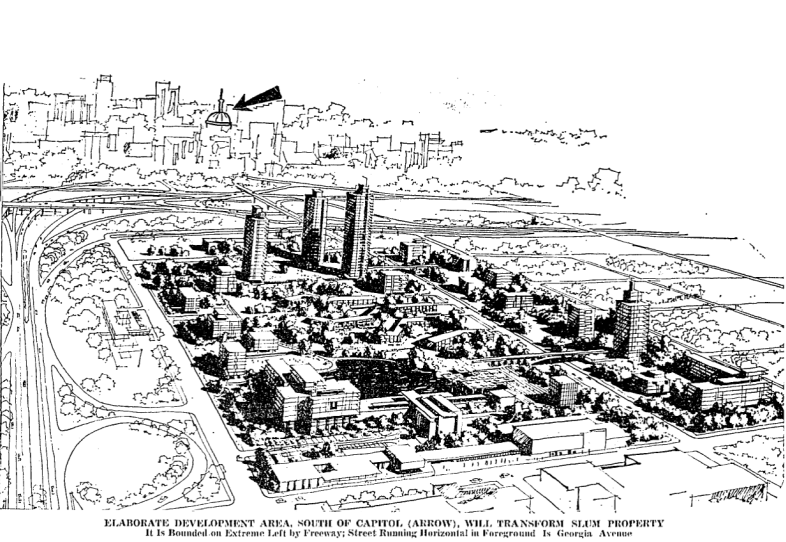
Private development schemes were proposed but went nowhere. Allen then devised a plan to offer the land to a major-league baseball franchise. He soon enticed the Milwaukee Braves to relocate, promising to build them a state-of-the-art facility just south of the Georgia State Capitol.
Southside development proposal, Atlanta Constitution, 1961
Construction of the building commenced in 1964 without neighborhood input, and was completed in 1965. Atlanta hosted the Beatles, and 34,000 of their fans, in the new stadium that summer, and the Atlanta Braves played their first regular season there in 1966. It was described by one young Braves employee as looking “like a spaceship” and by other observers like a “concrete doughnut.”
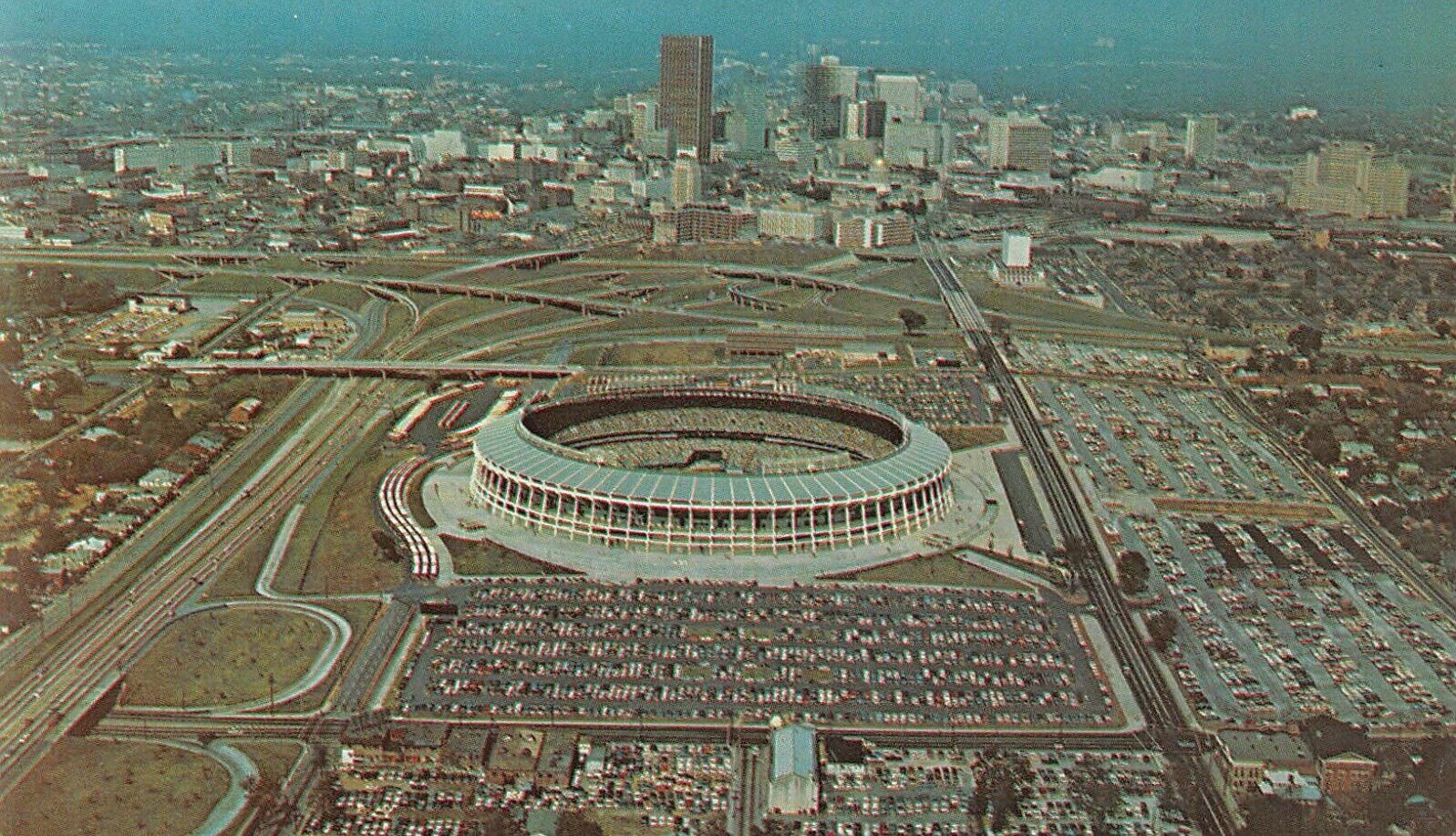
Georgia Avenue runs in the foreground, south of the stadium and parking lot
The combination of land clearance and residential flight from the area turned the demographics of these neighborhoods upside down. The population of the blocks west of Capitol Avenue plummeted, from nearly 12,000 in 1950 to 7,600 in 1960, to fewer than 3,000 in 1970. The racial makeup of those who remained in 1970 had flipped in two decades, from 85% white to 95% African American. In Summerhill, east of Capitol and north of Georgia Avenue, the population fell as well, though less precipitously. The historically-black neighborhood had always hosted a small white population, but by 1970 that population had nearly ceased to exist.
As the area’s population went from mixed-race and multiethnic to almost entirely African-American, several local public schools were “redesignated” for Black students. In 1962, it was announced that Cheney Stadium, the Georgia Avenue football field that had previously been restricted to use by white high schools, would now be used by the football teams of majority-black schools. Hoke Smith on Hill Street had been converted to a vocational training school in 1959. It became a regular high school again in 1967, serving the Summerhill community until 1985.