Conflicting Visions
Whose Neighborhood?
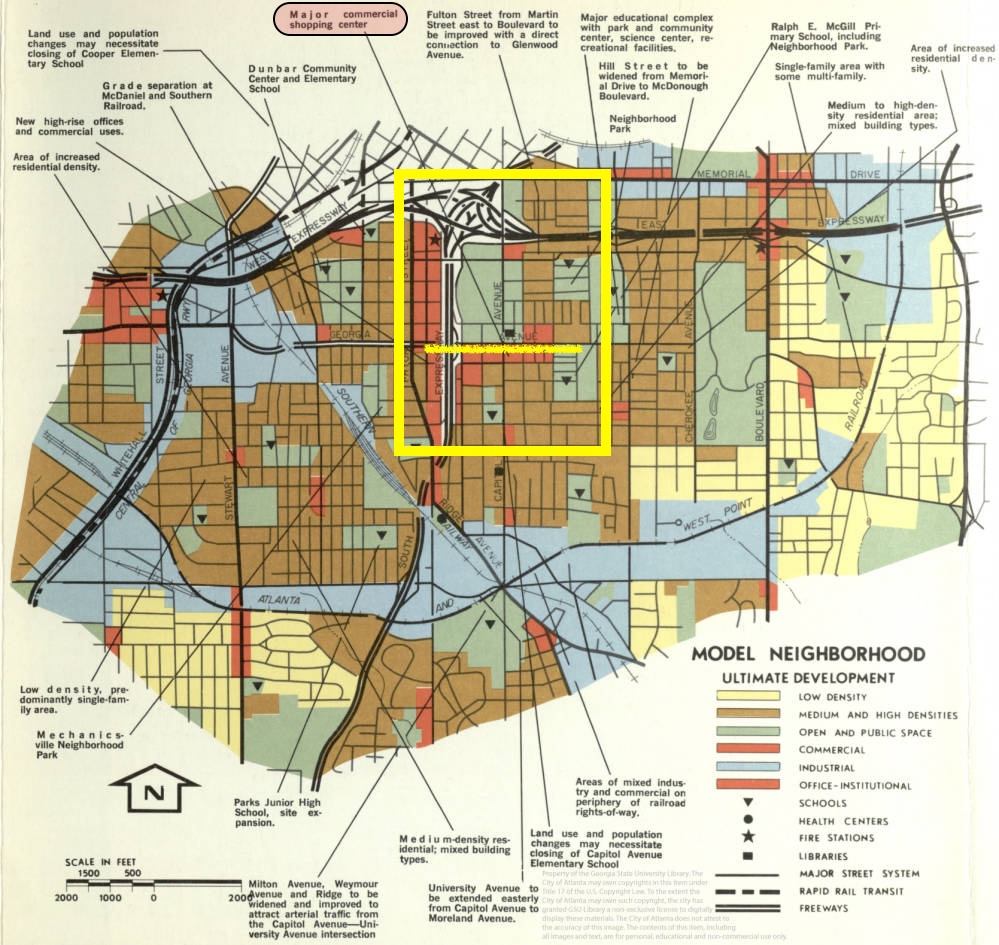
The selection of five neighborhoods surrounding the stadium as a “Model Cities” site offered some cause for optimism. A federally funded antipoverty program, Model Cities grants were distributed to 150 sites nationwide in the late 1960s and early 1970s. Atlanta’s leaders hoped that their grant would turn around a decade of blight, displacement, and decline, by supporting local residents as they administrated projects to improve and augment housing stock, repair streets and enhance public services, and increase the number and quality of job opportunities.
Model Cities planning and development map, 1970 — Summerhill and Southside are indicated by yellow box; Georgia Avenue by yellow line
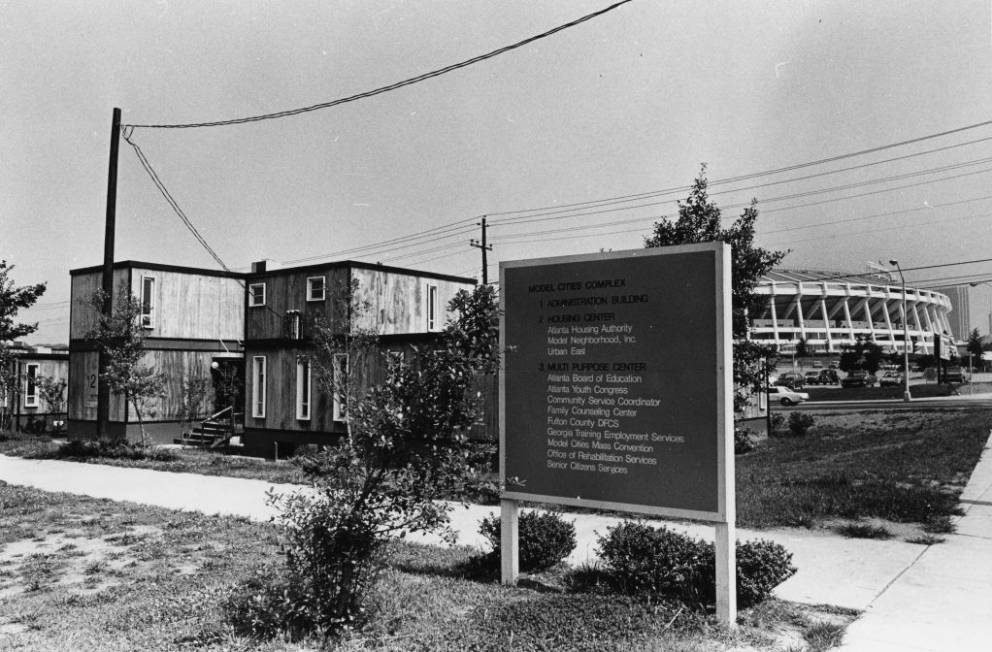
As the “Model Neighborhoods” map suggests, the program developed ambitious plans for housing, commerce, community facilities, and public green space. Georgia Avenue was designated a “major commercial shopping center,” and a Model Cities Complex, which housed job training facilities and a community services coordinating office, was soon constructed on Georgia Avenue, across the street from the Stadium.
Model Cities Complex on Georgia Avenue, 1970
But some of Georgia Avenue’s business owners presumed a different mission for Model Cities. In perhaps the first public appeal for the restoration of Georgia Avenue, Charles Zink, who had owned a barber shop on Georgia from the 1930s through the 1950s, described a vision of the street’s improvement that privileged development and revenue over general neighborhood rehabilitation. Visitors to the Stadium currently only park their cars in the neighborhood, he pointed out, but they could be spending money there as well. “Georgia Avenue could be made a place of beauty,” he wrote to the editors of the Constitution, “with high-rise motels, restaurants, snack bars, [and] drug stores that would pay good dividends and revenue to our city and state.” The street’s commerce, Zink suggested, should be geared toward game-going middle-class consumers, rather than to the neighborhood’s immediate needs.
This phase of the debate over Georgia Avenue’s potential gentrification ended almost as soon as it started. Model Cities efforts came to little, not only in Atlanta but almost everywhere it was instituted. By the time the program ended in 1974, more residents had been displaced than rehoused by Atlanta’s Model Cities efforts – often for ill-fated projects, such as public parks that became magnets for criminal activity.
The “stadium neighborhoods,” as they had come to be known, continued their economic decline. Local discontent flared to a blaze on several occasions. At least one such occurrence predated Model Cities. In September 1966, a Black Summerhill resident was shot and wounded by a police officer at Capitol Avenue and Ormond Street, a smaller commercial node at the southwestern end of Summerhill. Local residents responded with fury, breaking storefront windows and confronting Mayor Allen in person. After years of promising to address issues of ongoing racialized poverty and police brutality, they protested, municipal leaders’ only tangible response was to build a stadium in the middle of their neighborhood.
Summerhill’s unrest only lasted a few hours. But in cities all over the country, Black neighborhoods were erupting in violent rebellion over similar frustrations. Hoping to redirect local rage, Walt Anderson, a white New Yorker and former Marine, rented a former Buehler’s supermarket on Georgia Avenue. In that space, he founded the House of U.S.E. (Understanding, Stimulation, Education). Inspired by his own rough Brooklyn childhood, Anderson insisted that providing safe recreational space and job training for local youth would help keep them out of trouble. For several months, Anderson befriended, advised, and advocated for boys and young men from Summerhill, Peoplestown, and other stadium neighborhoods. City funding for his efforts soon dried up, and in spring 1967 he relocated the House of U.S.E. headquarters from Georgia Avenue to the Butler Street YMCA in the Sweet Auburn district – another majority-Black neighborhood suffering the disruptions of Atlanta’s urban renewal program.
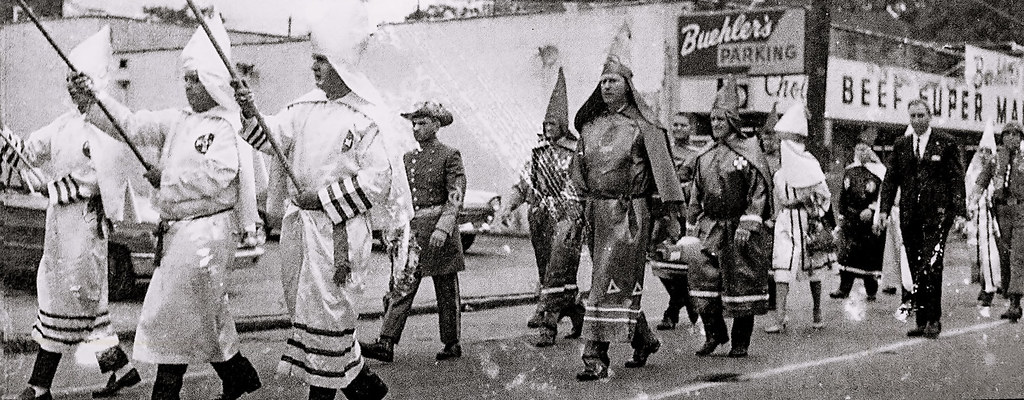
That June, the Ku Klux Klan paraded along Georgia Avenue, on their way from Grant Park to City Hall. This was not the white supremacist group’s first local appearance; former Summerhill and Southside residents report witnessing Klan marches, rallies, and other efforts to intimidate African Americans, Jews, Catholics, and Greek Orthodox.
Ku Klux Klan marching past Buehler’s Supermarket at Georgia Avenue SE and Terry Street, 1967
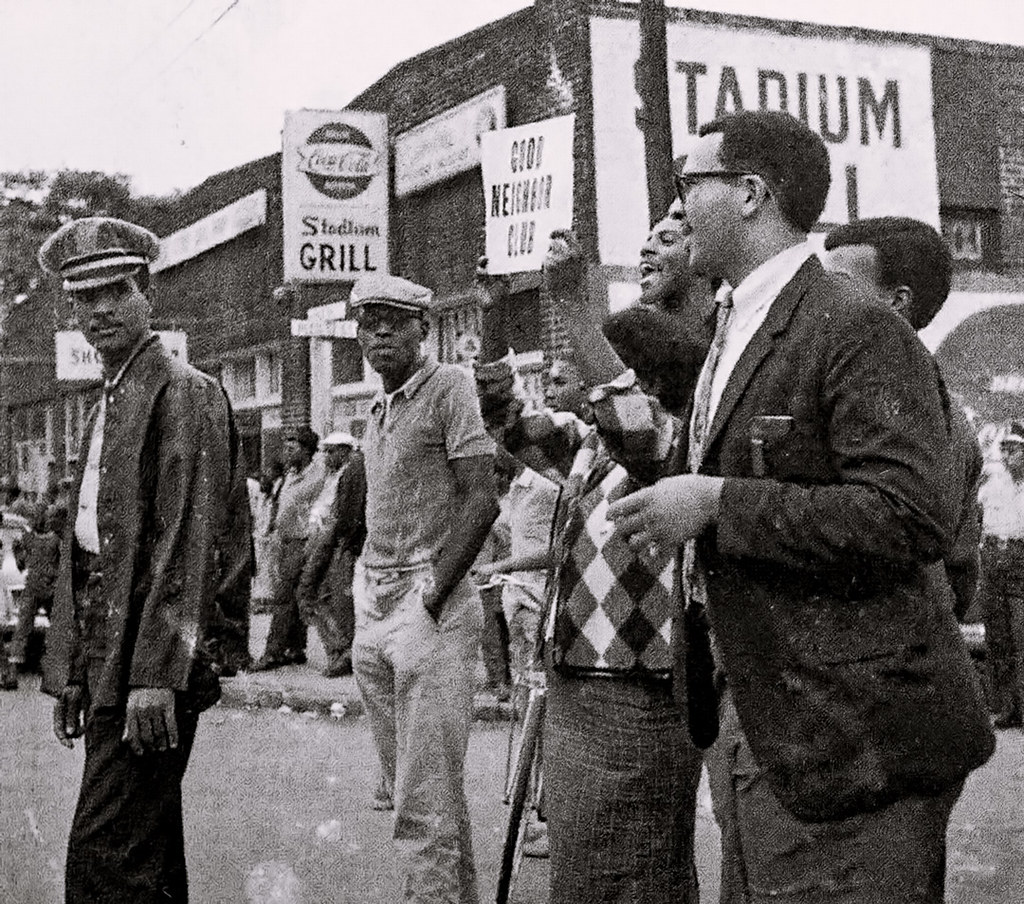
By the late 1960s, though, locals were uncowed. Summerhill came out to mock about 400 Klansmen and Klanswomen in full regalia and Confederate battle greys. One young man jeered at them, “what I got to do to join the Klan?” A young woman held up a sign for the “Good Neighbor Club,” a local committee founded by Summerhill residents dismayed and frustrated by the violence of the previous summer.
Protesting the Klan at Georgia Avenue SE and Reed Street, 1967
Then in 1970, another neighborhood uprising, one that lasted for nearly a year, took place right on Georgia Avenue. These protests seemed to be directed against a single neighborhood proprietor. But Georgia Avenue’s protesters were in fact articulating frustration and anger that Summerhill had been so completely abandoned by the city.