Urban Renewal
As the leveling of the Southside began, city leaders formulated even more radical changes to the neighborhood. The Federal Housing Authority approved Atlanta’s program for “slum clearance” projects in three older, poorer, and primarily Black neighborhoods to the east, south, and west of the central business district.
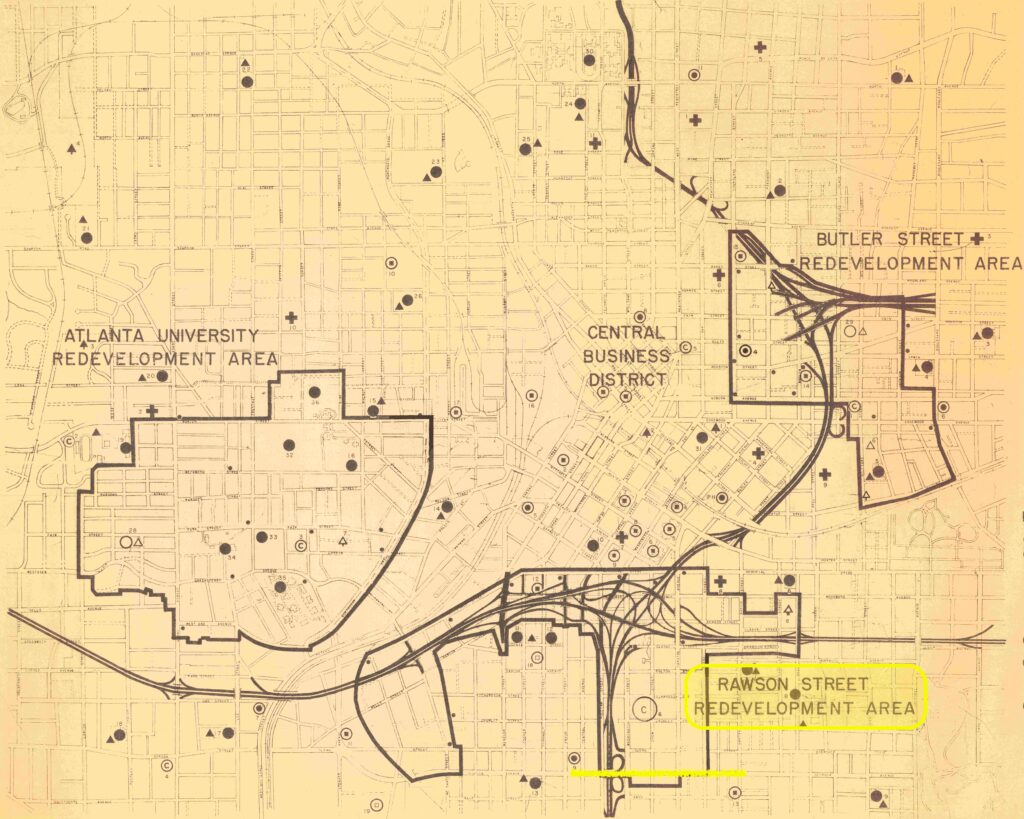
The southernmost of the three is referred to on this map as the “Rawson Street Redevelopment Area,” but was more commonly known by the names of Rawson and Washington Streets, which once intersected in the middle of what was now the highway interchange. It engulfed 337 acres, including more than half of the Southside, Summerhill’s northern and western edges, and a portion of the West End.
Urban Renewal map showing community facilities in redevelopment areas, 1958
Click here to see this map as an interactive overlay on a current street map (courtesy of GSU Library Digital Collections)
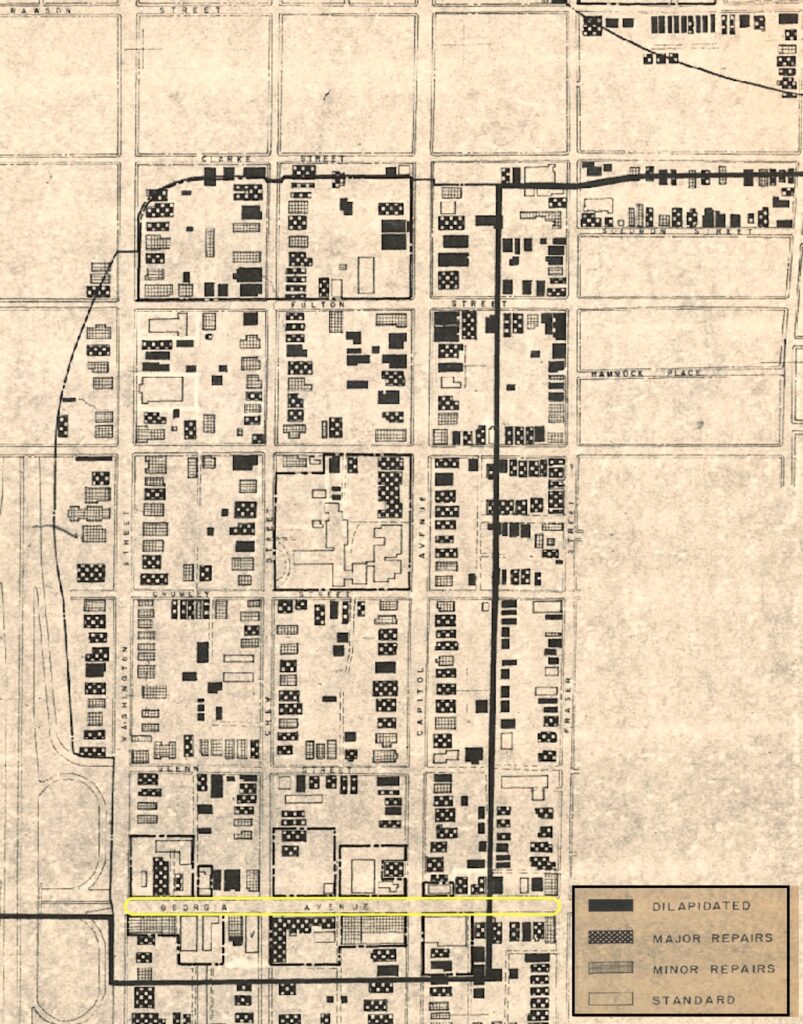
According to the city’s Planning Department, the majority of physical structures in this area were at best in need of repair, and at worst dilapidated beyond salvaging. This evaluation of the area’s buildings helped to justify its designation as a “slum” to be cleared, rather than as an older neighborhood to be restored.
Map of condition of structures in Rawson-Washington Urban Renewal area, 1958. Georgia Avenue is circled in yellow.
Click here to see this map as an interactive overlay on a current street map (courtesy of GSU Library Digital Collections)
Over the next several years, thousands of residents were forced to relocate from Summerhill and the Southside, often without sufficient warning or adequate compensation. Nearly a third of those forced out of their homes by the Rawson St. redevelopment project were white – an unusually high proportion for Atlanta’s urban renewal-era displacement, considering that African Americans made up 89% of displaced families citywide. For Black residents with resources to move to the suburbs, residential segregation still constricted their housing options. Overall, Black Atlantans displaced by urban renewal and other municipal projects consistently outnumbered the residential options available to them, setting in motion a housing crisis that would affect the city’s Black community for decades to come.
Of the 75 businesses displaced by Rawson-Washington, only 57 resumed operations in a new location; the rest simply shut down. Some Georgia Avenue merchants, hoping to make urban renewal work for their businesses, proposed to city leaders that clearance plans include the creation of parking facilities for shoppers. After all, expressway travelers could access Georgia Avenue directly via a small cloverleaf interchange. William B. Austin, of Austin’s Super Market; Jack Novak, owner of Manhattan Bakery; Arthur French, of French’s Ice Cream; and Alpha Fowler Jr.,owner of the Empire Theater were among these merchants. Concerned that shoppers would not drive to Georgia Avenue unless parking lots were built “in front instead of behind mercantile establishments,” they advocated a new layout that prioritized ease of automobile access to both the street and the store – a style that would soon be common in suburban strip mall design.
The hordes of driving shoppers never arrived. The highways severed the adjacent neighborhoods from other parts of the city and isolated them from one another, and from the commercial district they had relied upon for decades. For the businesses as reliant upon local residential patronage as Georgia Avenue was, the expressway and the Rawson-Washington project proved to be the first of many brutal blows. As Stanley Bernath, Alex Bernath’s son, noted, the clearance of dozens of blocks, and thousands of residents, “took all of our customers away.”
Credits and Sources for “Business Booms”